Intertidal Zone: Conversations with Whales
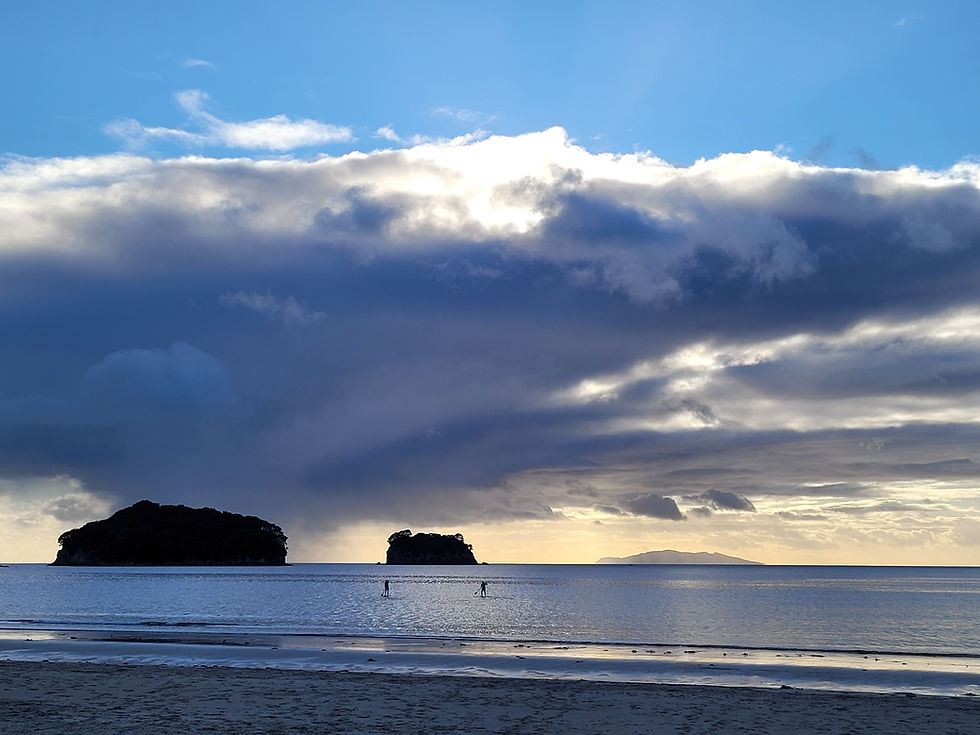
We prepared our kayaks on the beach. Each guide decked out in tow ropes, PFDs, and an excessive amount of zinc, paling our deep-set tans and classifying us as people who regularly brave the New Zealand sun. Ready, we head out onto the water for a start of season review on rescuing techniques. The water was choppy. The sky, clouded, protecting us a smidge from the aforementioned rays. It was not the ideal, picturesque day that tourists like, but the perfect day to put us guides through some scenarios.
Heading out to the sacred island of Whenuakura, commonly referred to as Donut Island to the tourists, we mentally prepare ourselves to get into the water, go limp, and trust that our coworkers will chuck us back into our kayaks before the waves pull us onto the rocks. Following the curve of the island to the right, we stop in front of the tunnel entrance, created by the sheer will of the sea and opening up in the middle, giving the island its desert-based nickname. Our boss pivots his kayak to face us to begin the first scenario, only to be interrupted by a boat coming around the back end.
"There's a whale or something over there!" shouts that captain, gesturing behind him.
We all look at each other and grin. Training would have to wait. We move around the bend to see two orcas off in the distance. Dipping, diving, their fins cutting through the sea like a hot knife through butter, smooth and effortless.
"Hannah-" I turned to my friend and fellow guide, Shay. Her eyes widened. "Look behind you!"
I look to my left to see the fin of a third orca coming straight towards me.
My instinct briefly kicked in. I need to move, I thought. I gotta get out of the way... Looking side to side, I quickly realized that there was no getting out of the way. Some nugget of knowledge squirmed briefly into my head about sound traveling underwater. If I put my paddles in the water, it would make a noise. Would that aggravate, or pique the orca's curiosity?
The lurch in my chest settled into acceptance. Whatever was going to happen, was going to happen. So I stayed still, paddle held aloft, watching the fin get closer.
Almost a year later, I sit across from Dr. Bob Turner as he speaks about the inspiration behind the UNESCO Biosphere designation for Átl'ḵa7tsem, Howe Sound. His words would then be stuck in my head for the subsequent weeks.
"The whales came back, and they're sort of forcing the conversation".
This idea of whales as communicators, as the trigger that gets people talking about the importance of the environment, really resonated with me. Something about whales invokes strong feelings. Their presence inspires us, demands that we take notice. While the environmental educator in me objectively knows that orca whales are biologically closer to dolphins, I am transported back to that encounter in New Zealand, as well as to other moments with some of the largest mammals on earth.
Another tour I gave, this time in my home waters, where I saw the breath in the distance, near the opening between Keats Island and Gibsons. My guests shrugged, surely, they thought aloud, its just a seal splashing around. But at that point, I was too familiar with the movements of seals and felt the presence of something bigger. This gut feeling was confirmed later, as whale watchers posted on Facebook pages about humpback sightings along the opening and up past Davis Bay. To see a whale is a rare site indeed, I am extremely fortunate to have had multiple sightings throughout my life. I am especially grateful for those sightings in the Howe Sound, where almost twenty years ago, no whale was sticking around. In fact, zooming out to encompass all of the Salish Sea, seeing a whale had become an impossible dream.
"Mr. Warren... is preparing whale boats and apparatus for waging war on the monsters of the Deep" (Source: The Daily British Colonist, Sept. 10th, 1866).
In the early 1860s, before whaling operations took place in the Strait of Georgia between Vancouver Island and the main land, humpback whales were a common sight. But by 1907, "the Humpback Whale population in the Salish Sea and Howe Sound was virtually wiped out" (Source: Nature Vancouver). This was due to the efforts of companies such as the Pacific Whaling Company which operated from Page's Lagoon, amongst others, including a Howe Sound Whaling Company. There is little to no record of Coast Salish Indigenous peoples participating in whale hunting, instead focusing on seals and sea lions, and only utilizing the whale when a dead one washed ashore. It wasn't until colonialism, that an onslaught was conducted in this region that essentially erased the giants of the sea within a less than 50-year span. But whaling would not officially end in British Columbia until 1967 when "the whale stocks were so diminished that the last provincial shore based commercial whaling station, at Quatsino Sound.... shut down for good" (Source: Nature Vancouver). However, population recovery was not an option in Átl'ḵa7tsem due to the conditions unregulated industry created for the Sound. Whales would not return here until meaningful strides were made to clean up our waters. Finally, in 2008, after a century, the first humpback sighting would be reported in the Howe Sound, (source: Bowen Island Undercurrent), and in 2010, the first grey whale would be spotted here in a 100 years (source: CBC). But current rumblings from Ottawa suggests that our joy may be short lived.
Conversations around whales have been on many British Columbian's minds of late with the current federal government's threats to their own laws and safety standards. The Species at Risk Act, or SARA, which protects the last 73 members of the endangered Southern Resident Orcas may be side-stepped to appease the cries of an Albertan premier. As the Southern Residents are on the Species at Risk Act, the federal government has a legal obligation to mitigate threats and create conditions that will help increase and stabilize their population. Instead, it looks like this government is determined to push forward illegal projects that will directly bring the Southern Residents to extinction, threaten other marine species that we only have just gotten back in the past twenty years, and jeopardize BC's health, safety and economy.
The fin got bigger and bigger, until it was so close, that if I reached out, I could touch it. Instead, I close my eyes just as she dipped down underneath my kayak. I open them, to see my coworkers in silent disbelief, looking at the water as she continues below, and comes up on the other side of us.
This once-in-a-lifetime experience didn't necessarily change me. But it took something inside of me and rooted it down. The orca did not touch me, and yet, it had consumed me. I feel my heart break at every threat being hurled at these creatures in my home country. A fury and sickness at the indifference towards death that those sitting in positions of power hold. But when I look out to sea, I feel the warmth of breath as the teeth close shut around me and we sink down together. An echo of a voice appears in my mind as I sit in the maw of the whale.
It asks, "what are you going to do about it?"
Hannah Brunn
To learn more about the Southern Resident Orcas and how federal fast-tracking is threatening BC, please click on one of the following articles. Included are also two additional sources on Humpbacks in the Salish Sea that I found particularly helpful in getting an understanding of this history.
Humpback Whales in the Salish Sea
Southern Resident Orcas and SARA
Threats to our environment, livelihoods, and democracy
Comments